Guessing Portions Is Hard: How Simple Tools Help
Most of us believe we have a good sense of how much we eat, and it turns out that is one of the trickiest things for any human to judge, whatever their size. The wonderful news is that a few simple tools can take the guesswork out, and they are easy and even fun to use. This is general education, not medical advice.
Why guessing is hard (for everyone)
Portions are slippery. A bowl of cereal, a handful of nuts and a drizzle of oil can each be double what we think. Researchers have documented this gap for decades. A well-known 1992 study in the New England Journal of Medicine by Lichtman and colleagues followed ten people who reported eating very little but were not losing weight. When the team measured what they really ate and burned, the participants had underreported their food intake by an average of about 47 percent and overestimated their physical activity by about 51 percent. Their metabolism was normal for their size.
That was a small group, and it would be unfair to read it as a flaw in any one person. Later expert reviews have pointed out that self-reported eating and activity are unreliable in research across many groups, which is why scientists use measurements wherever they can. It is simply how human memory and estimation work, and it is nothing to feel bad about.
Friendly tools that close the gap
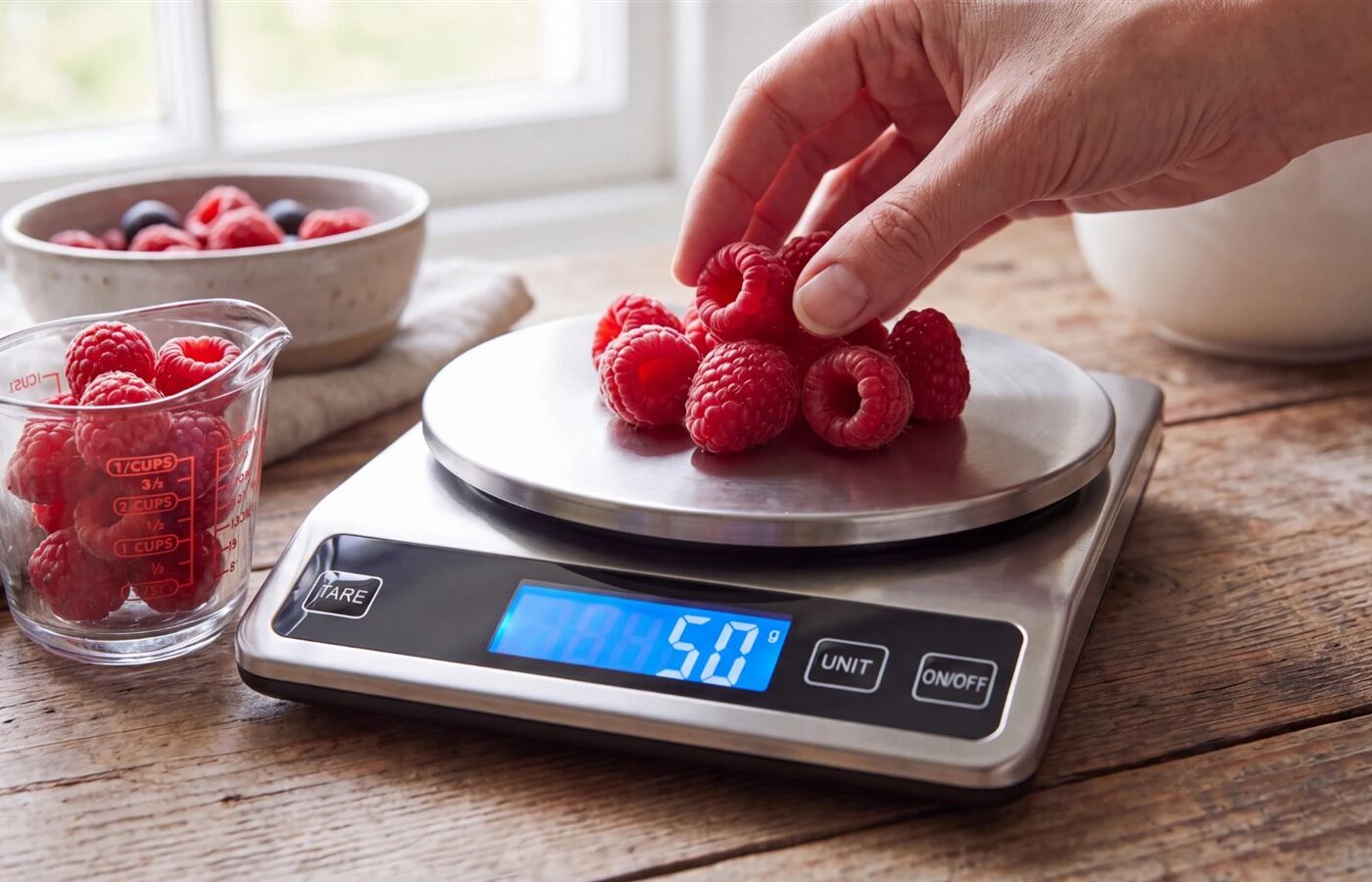
- A kitchen scale. Weighing food for a week or two is a quick way to learn what a real portion looks like. Many people then eyeball more accurately afterward.
- Measuring cups and spoons. Especially handy for oils, nut butters, cereal and grains.
- Nutrition databases and barcode scanning. Looking up a food by its barcode or label is faster and more accurate than guessing. Our guide to calorie-tracking apps and our look at photo-based calorie counting describe how close these tools get.
- Reading the serving size on the label. See our guide to reading a nutrition label in five minutes, because a package often holds more than one serving.
Using them without obsessing
- Treat it as a short experiment. A week or two of measuring teaches a lot, and you can stop afterward.
- Aim for useful, not perfect. Estimates will always be a little off, and that is perfectly fine.
- Be kind to yourself. Learning that a portion was bigger than you thought is simply helpful information, not a verdict.
Where Weight Wire fits
Disclosure: Weight Wire offers free tools that help here, and they have not been studied in the research above. Food Lookup lets you search foods, scan a barcode or read a nutrition label, and the private journal adds up what you log. Our food journal guide explains why keeping a record tends to help. The numbers are estimates, not medical advice.
Sources
- Lichtman SW, Pisarska K, Berman ER, et al. Discrepancy between self-reported and actual caloric intake and exercise in obese subjects. New England Journal of Medicine, 1992;327(27):1893-1898 (figures from the abstract).
- Dhurandhar NV, et al. Energy balance measurement: when something is not better than nothing. International Journal of Obesity, 2015 (expert opinion on the reliability of self-reported intake and activity).
Weight Wire is free to read. A free account lets you save articles and use the private journal and food lookup, which are free to use too. Create my free account

Weight Wire Editorial Team
Writer at Weight Wire.