BMI: A Useful Starting Point, Not the Whole Story
Body mass index, or BMI, is one of the simplest health numbers you can calculate: your weight relative to your height. It is easy to find online and easy to criticize, and the truth sits comfortably in the middle. Once you know what BMI can and cannot tell you, it becomes a friendly, useful starting point. This is general education, not medical advice.
What BMI is good for
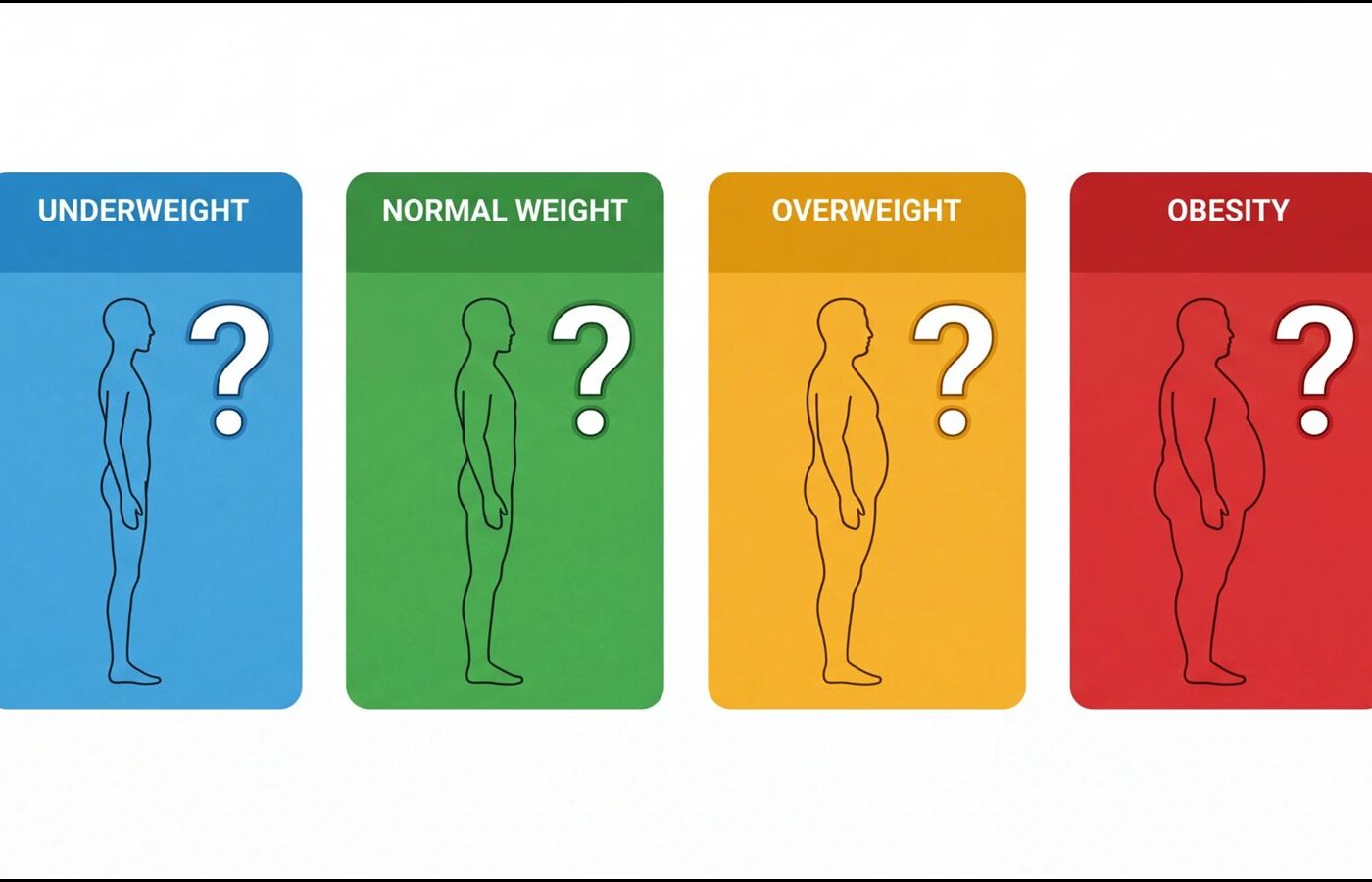
BMI is a quick screening number. Doctors and researchers use it because it takes seconds, needs nothing more than a scale and a tape measure, and lines up with body fat across large groups of people. The usual ranges are under 18.5 for underweight, 18.5 to 24.9 for a healthy range, 25 to 29.9 for overweight and 30 or above for obesity. It is also the number many medication guidelines and health programs use as a starting point, as we explain in our guide to who qualifies for a GLP-1 medication.
How well does it work?
A well-known 2008 study in the International Journal of Obesity by Romero-Corral and colleagues compared BMI with body fat in 13,601 adults. The findings are worth knowing:
- When BMI reached 30, it was very good at confirming excess body fat: about 95 percent specificity in men and 99 percent in women. Put simply, a BMI of 30 or more almost always meant a high body fat percentage.
- It was less good at catching everyone. Sensitivity was about 36 percent in men and 49 percent in women, meaning many people with high body fat had a BMI under 30.
- BMI was less accurate in the middle ranges, in men and in older adults.
What BMI cannot see
- Muscle versus fat. A muscular person can have a high BMI with little excess fat.
- Where fat is stored. Fat around the waist carries more health risk than fat elsewhere, and BMI does not show it.
- Age, sex and background. The same BMI can mean different things in different people.
- Health habits. It cannot tell you about fitness, diet, sleep or blood tests.
Getting more from your number
- Pair it with a waist measurement. Waist size and waist-to-height ratio add what BMI misses.
- Watch the trend. One reading matters less than how it changes over time, and a few pounds either way is perfectly normal, as we explain in our look at day-to-day weight changes.
- Add the bigger picture. Strength, energy, blood pressure and blood tests from your clinician complete the story. Our guide to smart scales and body-fat readings shows how far other tools can go.
- Treat it as information, not a judgment. A number is a starting point for a conversation, not a verdict on you, which fits with what we say in our article on weight stigma.
Try it for yourself
Disclosure: Weight Wire offers free calculators, and they have not been studied in the research above. You can work out your BMI with our BMI calculator, add a waist-based view with the body measurements calculator, and save your results in your private journal to watch your trend take shape. They give estimates, not medical advice.
Sources
- Romero-Corral A, Somers VK, Sierra-Johnson J, et al. Accuracy of body mass index in diagnosing obesity in the adult general population. International Journal of Obesity, 2008;32(6):959-966 (figures from the abstract).
- Centers for Disease Control and Prevention. About adult BMI (BMI as a screening tool).
Weight Wire is free to read. A free account lets you save articles and use the private journal and food lookup, which are free to use too. Create my free account

Weight Wire Editorial Team
Writer at Weight Wire.