Do Nuts Make You Gain Weight?
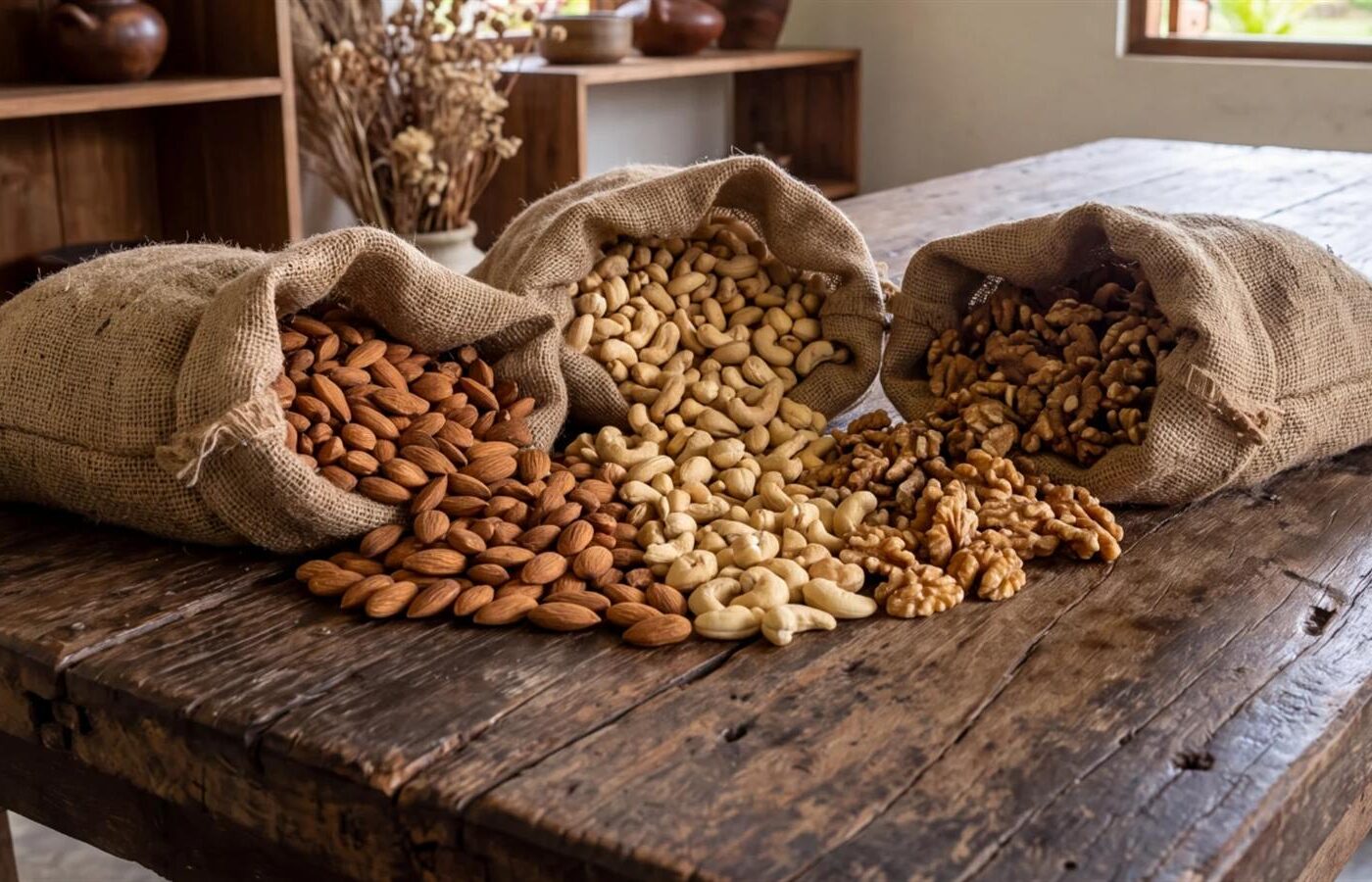
Nuts are one of those foods people worry about. They are rich in calories, so it seems logical that a daily handful would push the scale up. The research tells a more reassuring story. This is general education, not medical advice, and people with nut allergies should of course avoid them.
Why people worry
Most nuts contain somewhere around 160 to 190 calories in an ounce (about 28 grams, a small handful). They are mostly fat, and fat is calorie-dense. Add a few handfuls a day without changing anything else and, on paper, the total climbs.
Pooled trials on weight
Researchers have pooled randomized trials in which people ate nuts and were compared with others who did not.
- A 2013 meta-analysis in the American Journal of Clinical Nutrition by Flores-Mateo and colleagues combined 33 trials. Nut-enriched diets did not significantly change body weight (an average difference of about half a kilogram lower, with a range that included no change), BMI or waist circumference.
- A 2018 meta-analysis in Nutrition & Metabolism pooled 62 feeding trials and six cohort studies. It found a very small reduction in body weight, about 0.2 kilograms, which is too small to count as a weight-loss tool.
- A 2021 review by Nishi and colleagues in Obesity Reviews combined cohort studies and trials and also concluded that the worry that nuts add to body fat looks unwarranted.
Put simply, adding nuts to people’s diets in these studies did not make them gain weight, and might have helped a little.
Why the calories may not add up
Researchers have offered a few possible reasons, though none is settled:
- Nuts are filling, so people may eat somewhat less of other foods.
- Some of the fat is not absorbed, because it stays locked inside the nut’s cell walls. Our guide to calorie absorption describes a study in which almonds delivered fewer calories than the label suggested.
- Chewing and structure matter. Whole nuts are not the same as nut oil.
Keeping it practical
- Stick to about a handful a day. That is roughly an ounce, or a small palmful.
- Plain beats candied. Choose unsalted or lightly salted nuts rather than sugar-coated or heavily flavored ones.
- Nut butters count too, but a tablespoon or two is easier to overshoot than a handful of whole nuts.
- Put them in place of something, such as chips or pastries, rather than on top of everything else.
- Use them in meals. They fit into the pattern described in our guide to the Mediterranean diet.
Worth knowing
Many nut studies receive support from industry groups, and trial participants were often given nuts as part of a controlled plan, which can differ from everyday snacking. That is a reason to treat the results as encouraging rather than definitive. And if you are not already eating nuts, there is no need to start; this is only about easing a worry.
Sources
- Flores-Mateo G, Rojas-Rueda D, Basora J, Ros E, Salas-Salvadó J. Nut intake and adiposity: meta-analysis of clinical trials. American Journal of Clinical Nutrition, 2013.
- Nut consumption and risk of metabolic syndrome and overweight/obesity: a meta-analysis of prospective cohort studies and randomized trials. Nutrition & Metabolism, 2018 (PMC6013998).
- Nishi SK, et al. Are fatty nuts a weighty concern? A systematic review and meta-analysis and dose-response meta-regression of prospective cohorts and randomized controlled trials. Obesity Reviews, 2021 (PMC9285885).
Weight Wire is free to read. A free account lets you save articles and use the private journal and food lookup, which are free to use too. Create my free account

Weight Wire Editorial Team
Writer at Weight Wire.