Energy Density: Getting More Food for Fewer Calories
What if feeling full and eating well could go hand in hand, without counting every bite? There is a simple idea that helps with exactly that, and it is called energy density. It just means how many calories sit in a given weight of food. Once you see it, your plate gets a lot more interesting. This is general education, not medical advice.
Calories per bite
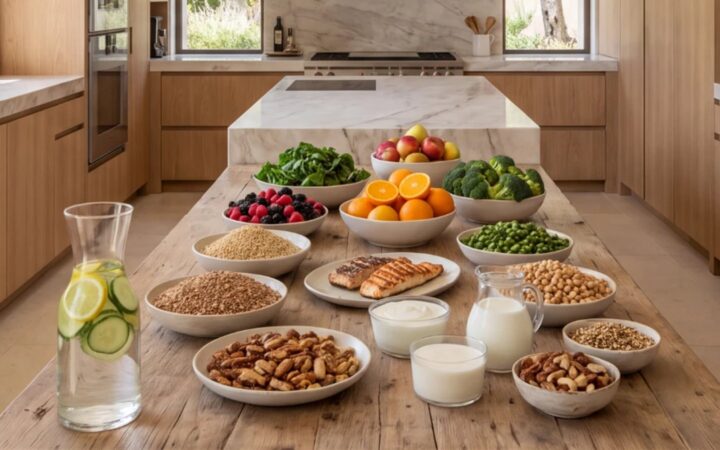
Imagine a cup of grapes next to a small handful of crackers. They may have a similar number of calories, but the grapes fill your bowl and the crackers barely cover a corner of it. The difference is mostly water and fiber, which add weight and volume without adding calories. Fat works the other way: it packs about 9 calories into every gram. So foods rich in water, such as vegetables, fruit, broth-based soups and beans, tend to be low in energy density, while oils, fried foods and many snacks are high.
Researchers use this to explore a practical question: if you eat a similar weight of food each day, can you feel satisfied while taking in fewer calories?
A salad at the start of the meal
In a 2004 study from Barbara Rolls’s group at Penn State, volunteers had lunch with a first-course salad or with no salad before a pasta main. The salads differed in how calorie-dense they were and how big the portion was. When the first course was a large, low-calorie-density salad (about 300 grams), people ate about 12 percent fewer calories at the meal, roughly 107 calories, than when they had no first course. A smaller salad cut intake by about 7 percent, or 64 calories. The benefit was tied to the low-calorie-density salads.
A year of eating more food, not less
A longer trial put the idea to the test. In 2007, Ello-Martin and colleagues randomly assigned 97 women with obesity to one of two diets for a year. Both groups were asked to cut back on fat. One group was also asked to add more water-rich foods, especially fruits and vegetables. Nobody was given a calorie target.
- Weight: among the 71 women who finished the year, the fruit-and-vegetable group lost about 7.9 kg and the other group about 6.4 kg.
- Hunger: the fruit-and-vegetable group reported feeling less hungry.
- The plate: their diets were lower in energy density (about 1.23 compared with 1.46 calories per gram) and they ate about 225 grams, roughly 25 percent, more food by weight each day.
It is one trial in women, it relied on self-reported food records, and about a quarter of participants did not finish, so it is encouraging rather than final. Still, it matches what many people notice: a plate with plenty of produce can be both filling and lighter.
Easy ways to try it
- Start with something watery. A broth-based soup or a big salad before the main course is a pleasant habit, and our piece on soup before the meal has more.
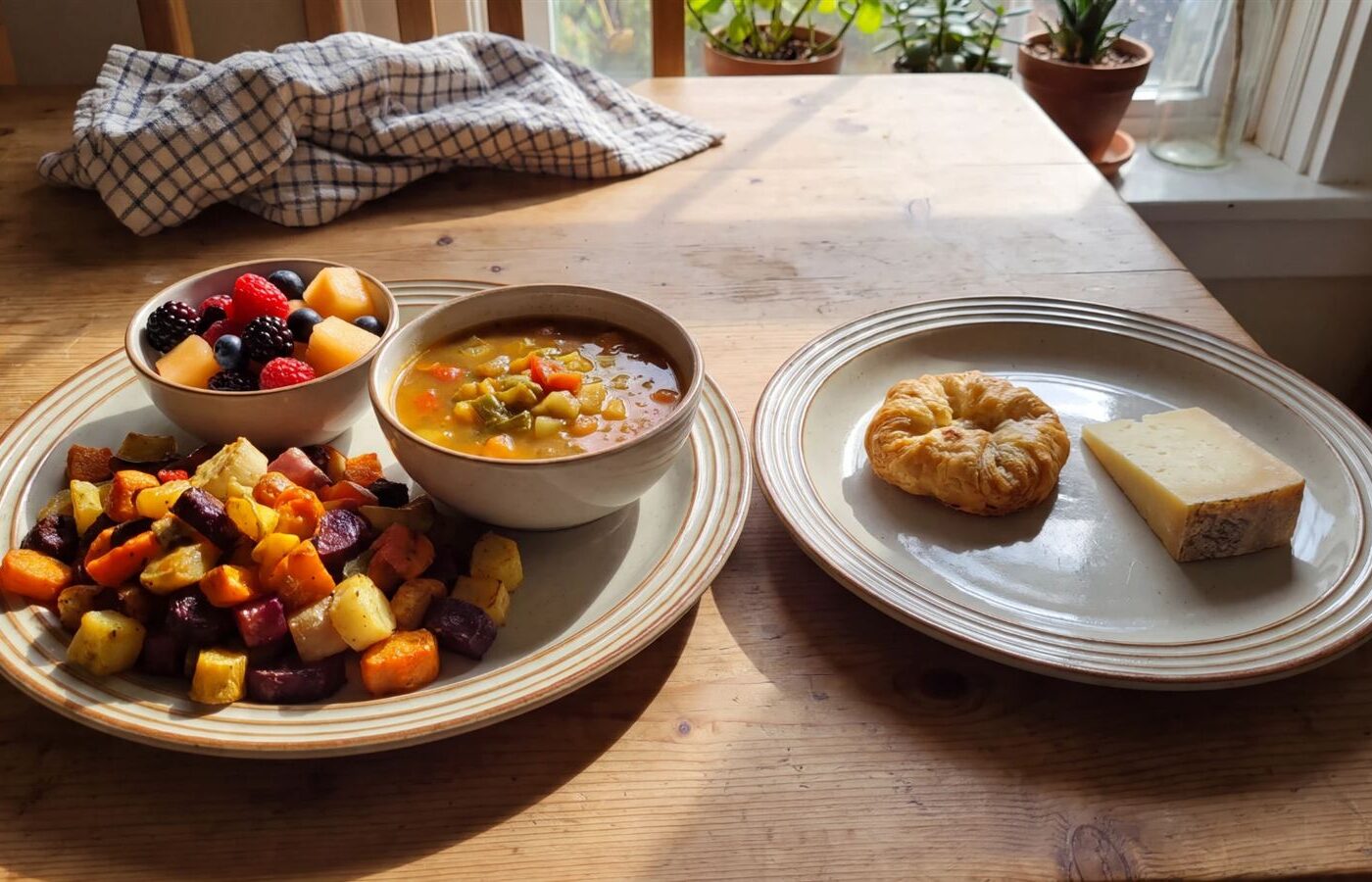
- Add, don’t only subtract. Stir vegetables into pasta, eggs and stir-fries, or add fruit to breakfast, so the bowl is fuller.
- Bring in beans and lentils. They add bulk and protein, as we describe in our guide to beans and fullness.
- Keep the foods you love. Nuts, olive oil, cheese and chocolate are higher in energy density, and that is fine in the right amounts. The idea is balance, not a ban list.
- Mind portions. Bigger plates and packages nudge us to eat more, which we explain in our portion effect guide.
Work it out for any food
Weight Wire’s free Food Lookup shows calories per 100 grams. Divide that number by 100 and you have calories per gram, the number researchers use. For example, 40 calories per 100 grams is 0.4 calories per gram. You do not need to do this for every meal, but it can be a fun way to see why some foods fill you up more than others. For more on fullness, see why some foods fill you up.
Sources
- Ello-Martin JA, Roe LS, Ledikwe JH, Beach AM, Rolls BJ. Dietary energy density in the treatment of obesity: a year-long trial comparing 2 weight-loss diets. American Journal of Clinical Nutrition, 2007;85(6) (design, completers, weight, hunger, energy density and food weight read from the open-access paper; funded by the U.S. National Institutes of Health).
- Rolls BJ, Roe LS, Meengs JS. Salad and satiety: energy density and portion size of a first-course salad affect energy intake at lunch. Journal of the American Dietetic Association, 2004;104(10):1570-1576 (percentage and calorie figures from the abstract and a secondary summary; the full paper was not read).
Weight Wire is free to read. A free account lets you save articles and use the private journal and food lookup, which are free to use too. Create my free account

Weight Wire Editorial Team
Writer at Weight Wire.